Lesson 3.4
Where to keep savings
High-yield savings, interest rates and FDIC insurance. 5 min read
The big ideaKeep savings safe, easy to reach and earning interest, but not in your checking account.
Savings for emergencies and sinking funds should be safe and quick to reach. That rules out the stock market, where the value can drop right when you need it. It also rules out checking, where it gets spent.
High-yield savings
A high-yield savings account is a savings account that pays much more interest than the usual one. They’re common at online banks and credit unions. Rates change often, so compare a few before you open one, and look for no monthly fees or minimums.
APY (annual percentage yield) is what your money actually earns in a year, with interest on interest included; APR is a yearly rate without that, used mostly for loans and cards. For savings, compare APYs.
Example · Same $15,000, two accounts (example rates)
At 0.01% APY, $15,000 earns $1.50 in a year. At 4.00% APY it earns $600. If the Riveras save $620 a month for five years, that’s $37,200 put in. At about 4% it grows to about $41,100, roughly $3,900 more than at 0.01%.
Try it with your numbers
$243,994 after 30 years
You put in
$72,000
Growth
$171,994
Waiting 10 years costs
$139,809
You’d have $104,185
What you put in GrowthYears along the bottom
Monthly compounding, deposits at the end of each month, no taxes or fees. Real returns go up and down; this isn’t a promise or investment advice.
FDIC insurance (checked November 2026)
- Deposits at an FDIC-insured bank are insured up to $250,000 per depositor, per bank, for each account ownership category (for example, single and joint accounts are counted separately).
- It covers checking, savings, money market deposit accounts and CDs.
- It doesn’t cover stocks, bonds, mutual funds, annuities, crypto or what’s in a safe deposit box.
- Credit unions have the same $250,000 coverage through the NCUA.
Before you open an account, check that the bank is FDIC-insured on fdic.gov, or the credit union is NCUA-insured. Some apps hold your money at a partner bank, so check who that is.
Key notes
- Short-term savings belong in insured savings, not stocks and not checking.
- Compare APYs: what your money actually earns in a year.
- FDIC: $250,000 per depositor, per bank, per ownership category.
- Credit unions: the same coverage through the NCUA.
A steward’s view
Caring for savings means keeping it safe and letting it grow, not leaving it where it quietly loses value.
Do it in the app
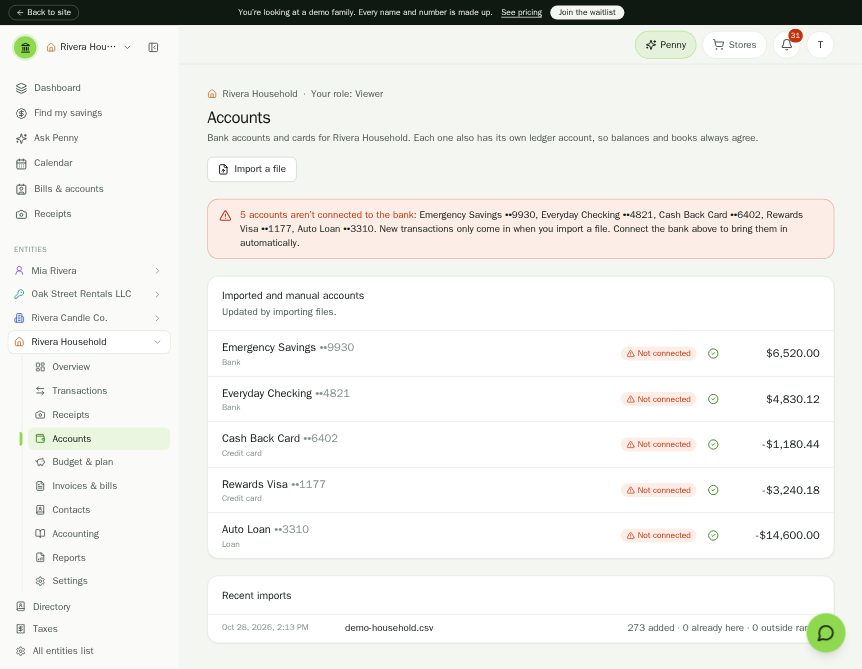
See your savings next to everything else
- 1Open the entity the savings account belongs to, go to Accounts and click Connect a bank. Pick the savings account to share.
- 2Balances come in on their own, so your goals in Budget & plan → Goals read the real number.
Quick quiz
3 questions
Go deeper
- FDIC: Deposit insuranceThe official rules, and how to check that your bank is covered.
- NCUA: Your insured fundsHow credit union accounts are insured.
Track this automatically in Stackyard
Connect your accounts once and Penny watches for this every time your banks sync.
For education only; not financial, tax or legal advice. Store rules, rates and tax figures change; check the source before you act.