Lesson 12.2
How much coverage is enough
Add up debts, income, mortgage and college (DIME). 5 min read
The big ideaAdd up what your family would need, subtract what you already have, and round up. Many families land somewhere around 10 to 12 times their yearly income.
There’s no perfect number, but a simple add-it-up method gets you close. Financial planners often use one called DIME: Debts, Income, Mortgage and Education.
- Debts: car loans, credit cards and anything else you’d leave behind.
- Income: your yearly income times the number of years your family would need it (often until the youngest finishes school).
- Mortgage: what’s left on the house, so your family can stay in it.
- Education: what you hope to put toward college or training for each child.
Then subtract what you already have: savings, investments and any coverage through work. What’s left is about how much coverage to look for.
Example · The Rivera family
Luis earns $60,000. The family would need it for about 10 years ($600,000), plus $20,000 of other debts, $200,000 left on the mortgage and $50,000 for college: $870,000. They have $20,000 saved, so they look for about $850,000 of coverage on Luis.
Rounding up costs less than you’d think. Going from $500,000 to $750,000 of coverage usually adds only a little to the monthly price, because the base cost of a policy is already paid.
Key notes
- DIME: add Debts, Income (times years needed), Mortgage and Education.
- Subtract savings, investments and work coverage.
- Many families end up near 10 to 12 times their yearly income.
- Check the number again after big changes: a new baby, a new house, a raise.
A steward’s view
Planning for a hard day isn’t fear; it’s wisdom. Counting the cost ahead of time lets your family grieve without also facing a money crisis.
Go deeper in Faith and money: Saving and wisdomDo it in the app
Find your numbers in the app
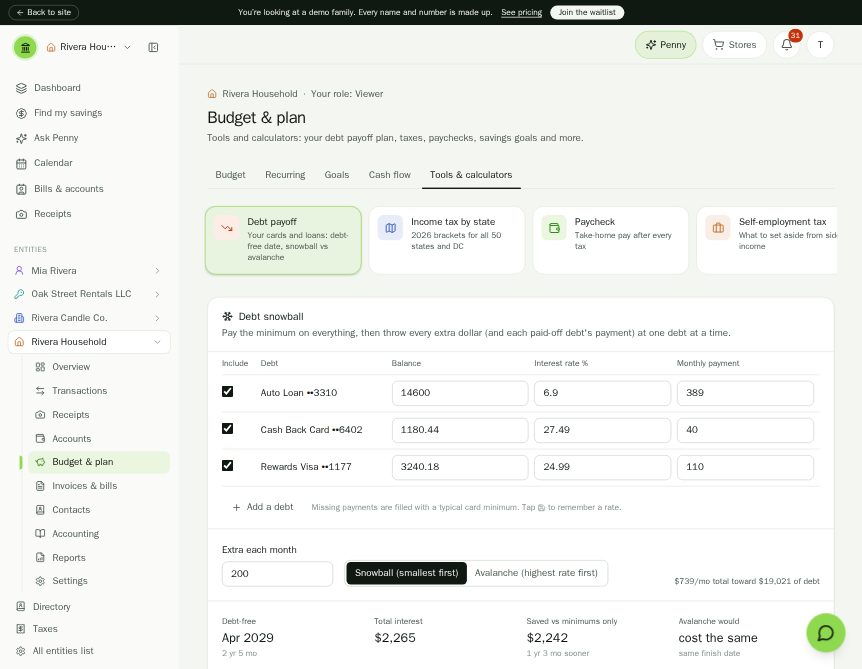
- 1Your debts and mortgage balance are on Accounts and in the debt payoff plan.
- 2Your yearly income is on Reports, or ask Penny “What did we earn last year?”
Quick quiz
3 questions
Go deeper
- NAIC Life Insurance Buyer’s GuideHas a worksheet for estimating how much coverage you need.
Track this automatically in Stackyard
Connect your accounts once and Penny watches for this every time your banks sync.
For education only; not financial, tax or legal advice. Store rules, rates and tax figures change; check the source before you act.