Lesson 13.4
How the money grows
Stocks, index funds, the S&P 500 and compounding, in plain words. 5 min read
The big ideaThe money is invested in hundreds of big U.S. companies at once. It will go up and down along the way; time is what does the work.
A Trump Account is not a savings account. There’s no interest rate and no guarantee. The money is invested, which means it buys small pieces of real companies.
What it’s invested in
- A stock is a small share of one company. If the company does well, the share is usually worth more.
- An index fund buys the stocks of many companies at once, following a list called an index. The law limits Trump Accounts to low-cost funds that follow a broad index of U.S. companies.
- Right now every account goes into one fund that follows the S&P 500, a list of about 500 of the largest U.S. companies. You can’t pick a different one yet.
- The law caps the fund’s yearly fee at 0.1%. That’s $1 a year for every $1,000 invested.
Why spreading out matters
Owning one company is risky: if it stumbles, so does your money. Owning hundreds means one bad company barely moves the total. That’s called diversifying.
Compounding
Whatever the fund earns stays in the account and is reinvested, so next year’s growth is on a bigger number. That’s compounding, and it needs time more than it needs big deposits.
Example · What time can do
If it grew 7% a year (a made-up rate, not a promise), $1,000 left alone would be about $3,500 at 18 and about $65,900 at 60. A $250 gift to an 8-year-old would be about $500 at 18. Add $100 a month to the $1,000 from birth and it would be about $46,600 at 18. Real results will be higher or lower.
Try it with your numbers
$243,994 after 30 years
You put in
$72,000
Growth
$171,994
Waiting 10 years costs
$139,809
You’d have $104,185
What you put in GrowthYears along the bottom
Monthly compounding, deposits at the end of each month, no taxes or fees. Real returns go up and down; this isn’t a promise or investment advice.
It will go down sometimes
Stock funds have bad stretches. A balance below what was put in is normal in the short run, and you may see it in your own child’s account. Because this money can’t come out until adulthood anyway, a dip years before then isn’t a loss you have to take. It’s still a real risk: nobody can promise what the balance will be at 18.
Checking the balance every day teaches worry. Checking it once a month with your child teaches patience.
Key notes
- A Trump Account is invested, not saved: no interest rate and no guarantee.
- Today it holds one low-cost fund that follows the S&P 500, about 500 large U.S. companies.
- Fees are capped by law at 0.1% a year.
- Growth is reinvested, so it compounds over time.
- The balance can fall as well as rise, especially over short periods.
A steward’s view
Patience is a money skill. Growth that takes years teaches a child to wait well.
Do it in the app
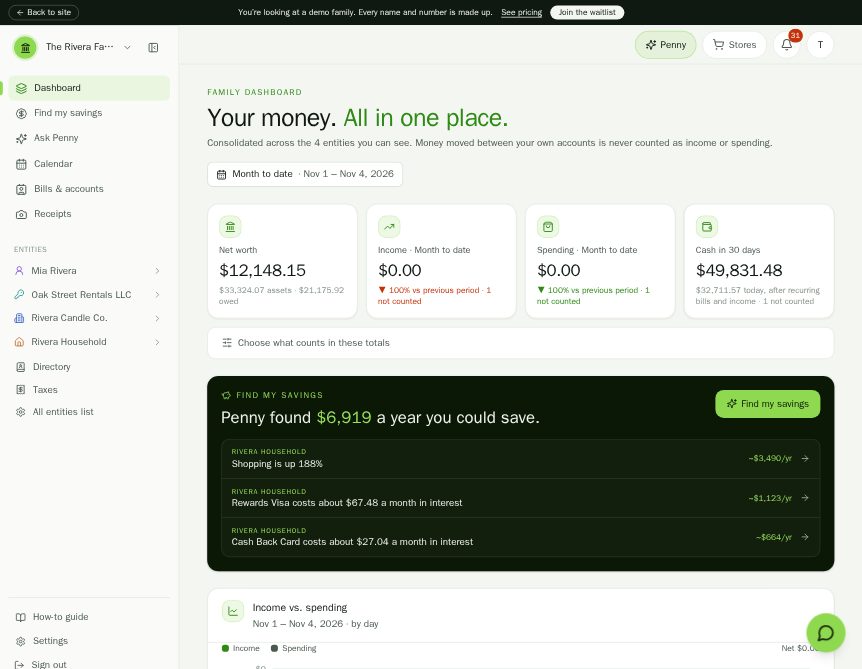
Watch it grow with the rest of their money
- 1Once a month, update the balance on each child’s Trump Account (their entity → Accounts) from the Trump Accounts app.
- 2Open the Dashboard and tap the arrow on one of the top boxes to show net worth. The kids’ accounts are part of the family total.
- 3Click a child’s card to see their own picture: the Trump Account next to their savings and goals.
Quick quiz
4 questions
Go deeper
- Investor.gov: Index fundsThe SEC’s plain explanation of what an index fund is and what to watch for.
- The Simple Path to Wealth, JL CollinsA readable case for low-cost index funds held for a long time.
Track this automatically in Stackyard
Connect your accounts once and Penny watches for this every time your banks sync.
For education only; not financial, tax or legal advice. Store rules, rates and tax figures change; check the source before you act.