Lesson 1.1
Your money snapshot
Net worth is what you own minus what you owe, and why it matters more than income. 4 min read
The big ideaNet worth is what you own minus what you owe, and it tells you more than your paycheck does.
Most people judge their money by their income. But income is only what comes in. What matters over time is what you keep.
Net worth is one number that shows it. Add up everything you own. Subtract everything you owe. What’s left is your net worth.
- What you own (assets): cash in checking and savings, retirement accounts, your home’s value, cars at what they’d sell for today.
- What you owe (debts): the mortgage balance, car loans, student loans, credit card balances, money owed to family.
Example · The Rivera family
The Riveras own a $310,000 home, $9,500 in checking and savings, $42,000 in retirement accounts and two cars worth $24,000. That’s $385,500. They owe $236,000 on the mortgage, $11,800 on a car loan, $3,200 on a credit card and $14,500 in student loans. That’s $265,500. Their net worth is $120,000.
Try it with your numbers
What you own
What you owe
$112,000 net worth
You own
$335,000
You owe
$223,000
- Owed $223,000
- Yours free and clear $112,000
Check it once a month or once a quarter. The direction matters more than the number: going up means you’re building wealth.
Use what things would sell for today, not what you paid. Nothing you type is saved or sent anywhere.
Why it beats income
Two families can earn the same and end up in very different places. One spends every raise. The other pays down debt and saves a little each month. Their incomes match; their net worth doesn’t.
A negative number is common, especially with student loans or a new car. It isn’t a grade. It’s a starting point, and the goal is simply to see it move up over time.
Use what a car would sell for today, not what you paid. Cars lose value every year, so update the number when you check your net worth.
Key notes
- Net worth = what you own minus what you owe.
- Income is what comes in; net worth is what you keep.
- A negative number is a starting point, not a failure.
- Check it every few months and watch the direction, not the size.
A steward’s view
You can’t care well for what you haven’t counted. Knowing what you have, and what you owe, is the first step in managing it faithfully.
“Moreover it is required in stewards, that a man be found faithful.” (1 Corinthians 4:2, KJV)Go deeper in Faith and money: Stewards, not owners
Do it in the app
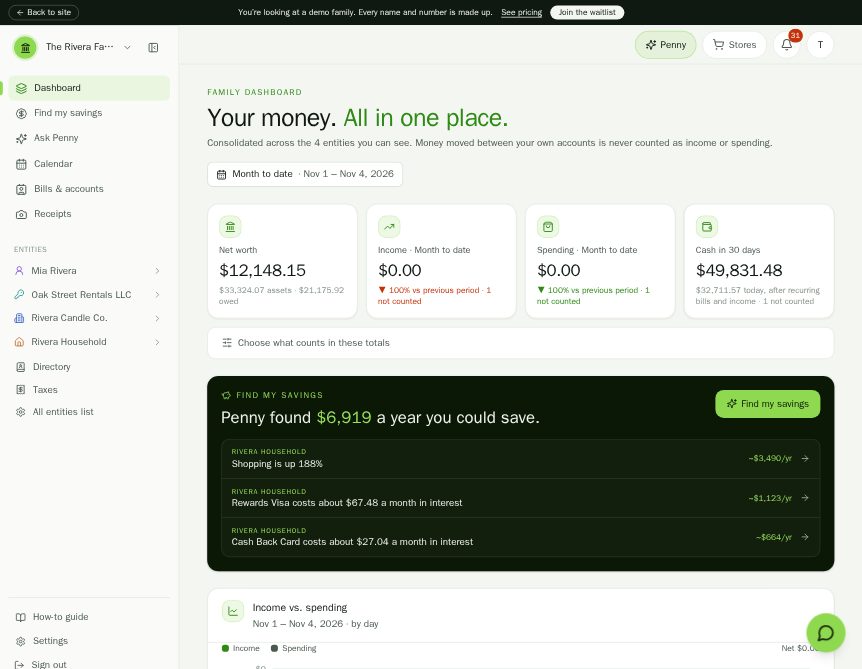
See your net worth on the Dashboard
- 1Open Dashboard (Home on a phone). The boxes at the top show Income, Debt and Spending across all your entities.
- 2Tap the little arrow in a box’s corner and choose net worth. Your choice is saved to your account.
- 3Click any entity card to see that entity on its own, like your household or your business.
Quick quiz
3 questions
Go deeper
- The Millionaire Next Door, Thomas Stanley and William DankoWhy many quiet savers end up wealthier than big earners.
Track this automatically in Stackyard
Connect your accounts once and Penny watches for this every time your banks sync.
For education only; not financial, tax or legal advice. Store rules, rates and tax figures change; check the source before you act.