Lesson 9.2
Allowance or commission?
Practice money or pay for chores, and spend, save and give jars. 5 min read
The big ideaWhether kids get an allowance or earn commissions, the real lesson is the same: let them make real choices with real money.
Kids learn money by handling it. The big question parents ask is whether that money should be tied to chores. Two popular books give two different answers, and both have good reasons.
Allowance as practice money
In The Opposite of Spoiled, Ron Lieber argues that allowance is a teaching tool, not a paycheck. Kids get a set amount to practice saving, spending and giving. Chores are done because everyone helps the family, not for pay. If allowance is pay, a child can simply decide to skip the chore and the money.
Commissions for work
In Smart Money Smart Kids, Dave Ramsey and Rachel Cruze suggest paying “commissions” instead. Kids earn money for specific jobs, and no work means no pay. The goal is to connect money with effort early, the way it works in adult life.
Many families mix the two. Basic chores are unpaid and expected. A small allowance covers practice money. Bigger extra jobs, like washing the car, can earn more. Pick what fits your values, explain it to your kids, and stick with it.
Spend, save and give jars
Whichever you choose, split the money into three jars (or three accounts). Spend is for now. Save is for a goal. Give is for helping others. Clear jars let younger kids see the money grow.
Example · The Rivera family
Mia, 15, gets $15 a week, which is $65 a month or $780 a year. Each week $7.50 goes to spend, $6 to save and $1.50 to give. Her save jar adds up to $312 a year, and she’s putting it toward a used bike.
Let kids make small mistakes with the spend jar. Regretting a $10 toy at age eight is much cheaper than regretting a car loan at 25.
Key notes
- Allowance (Ron Lieber): practice money, separate from chores.
- Commission (Dave Ramsey and Rachel Cruze): money earned by doing specific jobs.
- Many families blend them: unpaid family chores plus paid extra jobs.
- Split every dollar into spend, save and give.
- Pay on the same day each week, and let small mistakes happen.
A steward’s view
Spend, save and give jars teach kids that money is for living, for planning and for blessing others.
“And these words, which I command thee this day, shall be in thine heart: And thou shalt teach them diligently unto thy children, and shalt talk of them when thou sittest in thine house, and when thou walkest by the way, and when thou liest down, and when thou risest up.” (Deuteronomy 6:6–7, KJV)Go deeper in Faith and money: Teaching kids stewardship
Do it in the app
Track allowance on both sides
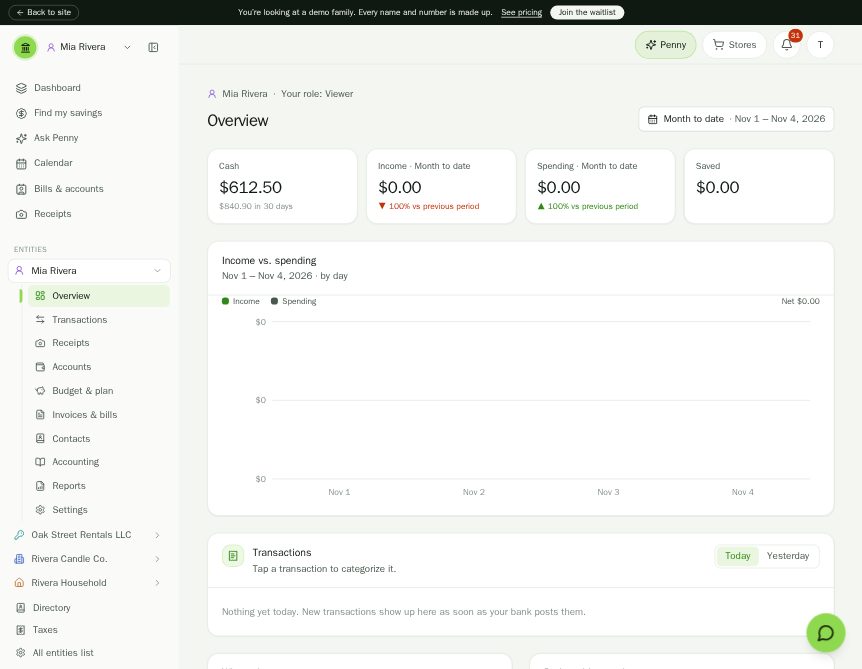
- 1Add your child as a Person entity (All entities list → Add an entity → Person) and add their bank or savings account.
- 2Allowance and money you give them are recorded as transfers between entities, so the household’s books and your child’s both stay right.
- 3Set a goal in your child’s Budget & plan → Goals. Invite an older child as a member with view-only access to just their own entity.
Quick quiz
3 questions
Go deeper
- The Opposite of Spoiled, Ron LieberRaising kids who are grounded and generous, with allowance as a teaching tool.
- Smart Money Smart Kids, Dave Ramsey and Rachel CruzeTeaching kids to work, save, give and avoid debt, using commissions.
Track this automatically in Stackyard
Connect your accounts once and Penny watches for this every time your banks sync.
For education only; not financial, tax or legal advice. Store rules, rates and tax figures change; check the source before you act.